
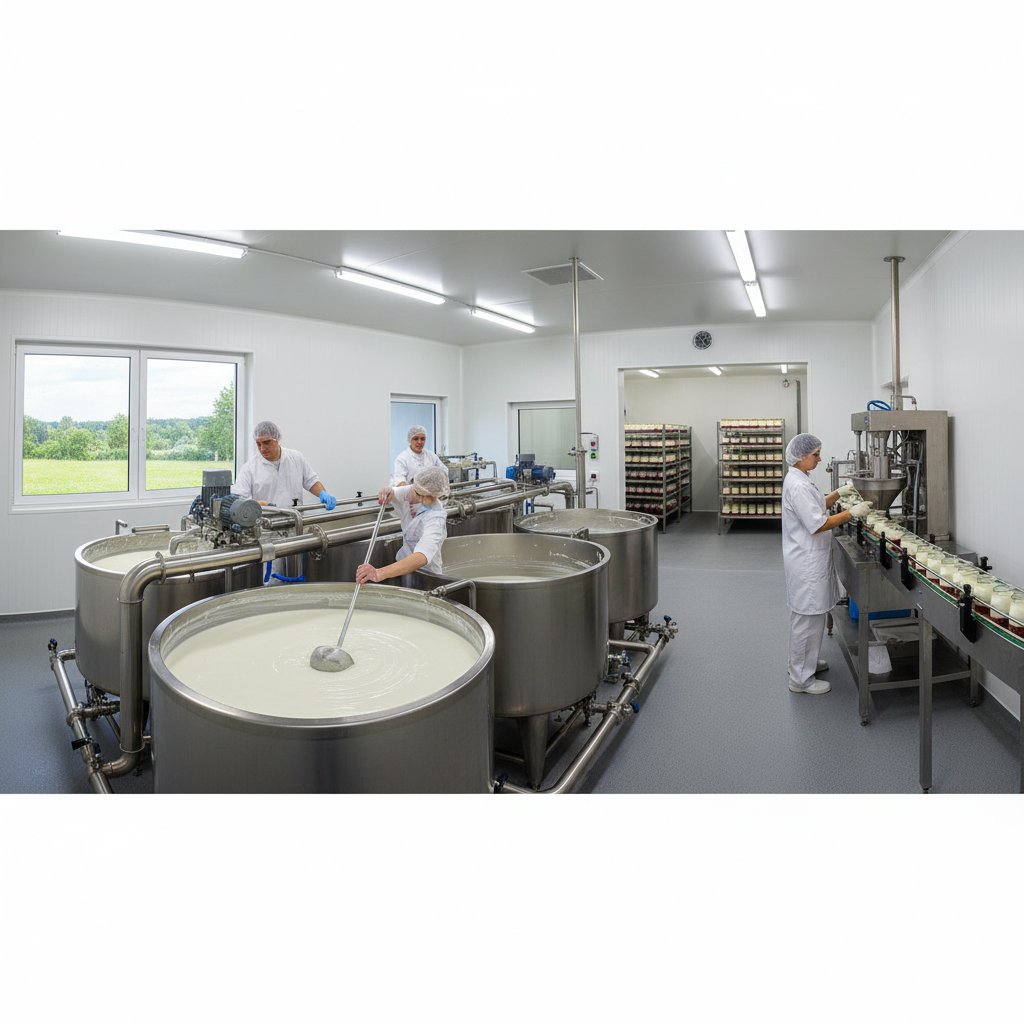
How is yogurt produced? This ancient food has been nourishing humans for thousands of years, yet the science behind its creation remains fascinating. Understanding how yogurt is produced reveals a carefully controlled fermentation process that transforms liquid milk into a creamy, tangy, probiotic-rich product. The global yogurt market has grown to over $125 billion in 2024, with projected growth to nearly $200 billion by 2033. This remarkable expansion reflects the increasing demand for healthy, convenient foods—and it all begins with understanding how yogurt is produced at commercial scale.
In this comprehensive guide, we explain exactly how yogurt is produced in modern dairy facilities, from raw milk reception to final packaging. Whether you’re a dairy professional, food scientist, or simply curious about how yogurt is produced, this guide covers every essential step.
How Is Yogurt Produced: The Science Behind Fermentation
Before exploring the step-by-step process of how yogurt is produced, it’s essential to understand the underlying science. Yogurt is a fermented milk product created through bacterial fermentation, specifically using Lactobacillus bulgaricus and Streptococcus thermophilus. These bacteria are not optional—they’re legally required in products labeled as yogurt.
The fermentation process is central to how yogurt is produced. These bacterial cultures consume lactose (milk sugar) and convert it into lactic acid. This acid production accomplishes several things:
- Lowers the pH of the milk (typically to around 4.5)
- Causes milk proteins to coagulate and thicken
- Creates the characteristic tangy flavor
- Produces compounds that contribute to yogurt’s distinctive aroma
This biological transformation is why learning how yogurt is produced matters—controlling fermentation conditions determines the final product’s taste, texture, and quality.
Step 1: Milk Reception and Standardization
The first step in how yogurt is produced begins with quality milk. Commercial yogurt production uses cow’s milk most commonly, though goat, sheep, and plant-based alternatives are also processed. The milk must be fresh, free from antibiotics (which would kill starter cultures), and meet strict quality standards.
Upon arrival at the processing facility, milk undergoes standardization—adjusting its composition before processing begins. This standardization is critical to how yogurt is produced consistently:
Fat content adjustment: Depending on the final product (full-fat, low-fat, or non-fat yogurt), the fat content is reduced or increased using separators and standardizing clarifiers.
Solids content fortification: The solids-not-fat (SNF) content is increased from milk’s natural 8-9% to 14-16%. This is accomplished by adding milk powder, concentrated milk, or whey protein concentrates. Higher solids content is essential to how yogurt is produced with proper body, texture, and stability.
U.S. regulations require all yogurt to contain at least 8.25% milk solids-not-fat. Full-fat yogurt must have at least 3.25% milk fat, while non-fat yogurt must contain less than 0.5% fat.
Step 2: Adding Stabilizers and Ingredients
The next phase in how yogurt is produced involves adding stabilizers and other ingredients to the milk blend. Stabilizers serve important functions:
- Prevent whey separation (syneresis) during storage
- Improve body and texture
- Keep fruit uniformly distributed in the final product
- Enhance mouthfeel and creaminess
Common stabilizers include pectin, gelatin, starch, and various gums. The specific stabilizers used affect how yogurt is produced with particular textural qualities—from thick and creamy Greek-style to smooth and pourable drinkable yogurt.
Sweeteners may also be added at this stage for flavored varieties, though many manufacturers add them after fermentation to avoid interfering with bacterial growth.
Step 3: Pasteurization and Heat Treatment
Heat treatment is a crucial step in how yogurt is produced, and it differs significantly from standard milk pasteurization. Yogurt milk undergoes a more intensive heat treatment, typically 85-90°C (185-195°F) for 5-30 minutes.
This high-heat treatment accomplishes several objectives that are essential to how yogurt is produced successfully:
Destroys competing microorganisms: Eliminates bacteria, yeasts, and molds that could interfere with controlled fermentation or spoil the product.
Denatures whey proteins: This is perhaps the most important aspect of how yogurt is produced with proper texture. Heat causes whey proteins (particularly β-lactoglobulin) to unfold and interact with casein micelles. This protein network creates a more stable gel that holds water better and produces a firmer, creamier yogurt.
Releases growth-stimulating compounds: Heat treatment releases compounds from milk proteins that actually stimulate starter culture growth.
Minimal flavor alteration: Despite the high temperature, this treatment doesn’t significantly alter milk’s flavor profile.
The heat treatment method can be batch (vat pasteurization) or continuous (HTST or UHT systems), depending on production scale and product requirements.
Step 4: Homogenization
Homogenization is performed either before or during heat treatment and is essential to how yogurt is produced with a smooth, uniform texture. This process forces milk through small orifices under high pressure (typically 2000-2500 psi or 20-25 MPa).
Homogenization accomplishes several goals in how yogurt is produced:
- Breaks fat globules into smaller, uniformly sized particles
- Prevents cream separation (fat rising to the surface)
- Creates a smoother, creamier mouthfeel
- Improves whiteness and visual appeal
- Produces a more consistent product
Without homogenization, fat would separate during fermentation and storage, creating an uneven texture. This step ensures that how yogurt is produced results in the smooth, creamy consistency consumers expect.
Step 5: Cooling and Inoculation
After heat treatment, the milk must be cooled before adding starter cultures—this is where the magic of how yogurt is produced truly begins. The milk is cooled to the optimal fermentation temperature, typically 42-44°C (108-112°F).
This temperature range is critical to how yogurt is produced effectively:
- Too low (below 40°C): Cultures grow too slowly, fermentation takes too long, and texture may suffer
- Too high (above 46°C): Cultures are damaged or killed, fermentation fails
- Optimal range (42-44°C): Balanced growth of both Streptococcus thermophilus and Lactobacillus bulgaricus
Once the correct temperature is reached, starter cultures are added. Commercial operations use carefully propagated, consistent starter cultures rather than simply using previous batches of yogurt. The inoculation rate is typically 2-3% of the milk volume.
The two required bacteria work synergistically in how yogurt is produced:
Streptococcus thermophilus grows first, producing lactic acid and formic acid. The formic acid stimulates the growth of L. bulgaricus.
Lactobacillus bulgaricus then becomes active, producing additional lactic acid and breaking down milk proteins to release amino acids that stimulate S. thermophilus.
This symbiotic relationship is fundamental to how yogurt is produced with proper flavor development and texture.
Step 6: Fermentation (Incubation)
Fermentation is the heart of how yogurt is produced. The inoculated milk is held at incubation temperature until the desired acidity is reached—typically pH 4.5 or slightly lower. This process takes 4-8 hours depending on several factors:
- Starter culture activity and concentration
- Incubation temperature
- Milk solids content
- Desired final acidity
How yogurt is produced in different styles affects the fermentation approach:
Set-style yogurt: The inoculated milk is poured directly into retail containers, and fermentation occurs in the cup. Fruit, if included, is placed in the bottom before adding the milk. This method produces a firm, gel-like texture.
Stirred (Swiss-style) yogurt: Fermentation occurs in large tanks. After reaching target pH, the coagulated yogurt is stirred to break the gel, then cooled and packaged. This produces a smooth, creamy texture.
Greek-style (strained) yogurt: After fermentation, a portion of the whey is removed through straining or centrifugation, creating a thicker, higher-protein product.
Drinkable yogurt: Fermented yogurt is agitated more vigorously and may be diluted slightly to achieve a pourable consistency.
Monitoring pH throughout fermentation is essential to how yogurt is produced consistently. Modern facilities use automated systems to track fermentation progress and determine precise endpoints.
Step 7: Cooling, Finishing, and Packaging
Once fermentation reaches the target pH, rapid cooling is critical to how yogurt is produced with consistent quality. The yogurt is cooled to 7°C (45°F) or below to:
- Stop further fermentation and acid production
- Stabilize the product texture
- Prevent over-acidification (which causes excessive sourness)
- Begin the shelf-life clock under refrigerated conditions
Cooling must be done carefully—cooling too quickly can cause textural defects and promote whey separation. Industrial cooling systems are designed to lower temperature efficiently while preserving yogurt quality.
After cooling, fruits, flavors, and other additions are blended into stirred-style yogurts. Common additions include:
- Fruit preparations (strawberry, blueberry, peach, etc.)
- Natural and artificial flavors (vanilla, honey, coffee)
- Sweeteners
- Additional probiotic strains
- Nutritional fortifications (vitamin D, fiber, protein)
The finished yogurt is then packaged in containers ranging from single-serve cups to multi-serving tubs. Packaging materials must protect against light (which degrades nutrients and causes off-flavors) and maintain product integrity throughout shelf life.
Understanding how yogurt is produced includes recognizing that the product remains “alive”—the bacterial cultures continue to exist in the yogurt. This is why yogurt must be kept refrigerated and has a limited shelf life compared to UHT dairy products.
Quality Control Throughout Production
Modern yogurt manufacturing relies on rigorous quality control at every stage. Understanding how yogurt is produced at commercial scale means appreciating the monitoring systems required:
- Milk quality testing upon reception
- Temperature monitoring during heat treatment
- pH and acidity tracking throughout fermentation
- Texture and viscosity measurements
- Microbiological testing for safety and culture viability
- Sensory evaluation for taste and consistency
Production management systems help track batch parameters, ensure regulatory compliance, and maintain traceability. As facilities scale, managing the complexity of how yogurt is produced—coordinating fermentation schedules, monitoring multiple batches, and maintaining quality records—requires sophisticated digital tools.
The Growing Global Yogurt Industry
Understanding how yogurt is produced has never been more relevant. The global yogurt market exceeded $125 billion in 2024 and continues growing at approximately 5-6% annually. Several trends are driving this expansion:
Health consciousness: Consumers increasingly seek probiotic-rich foods for digestive health.
Protein demand: Greek-style and high-protein yogurts appeal to fitness-focused consumers.
Plant-based alternatives: Almond, oat, coconut, and soy-based yogurts are capturing lactose-intolerant and vegan markets.
Convenience: Single-serve and drinkable formats fit modern on-the-go lifestyles.
Product innovation: Exotic flavors, functional ingredients, and clean-label formulations continue expanding consumer choices.
As demand grows, producers who master how yogurt is produced efficiently and consistently will capture expanding market opportunities.
Conclusion
How is yogurt produced? As we’ve explored, it’s a sophisticated 7-step process combining ancient fermentation principles with modern food science and technology. From milk standardization through controlled fermentation to careful cooling and packaging, each step in how yogurt is produced requires precision and expertise.
The transformation of milk into yogurt depends on creating optimal conditions for beneficial bacteria to thrive. Temperature control, timing, and careful monitoring determine whether yogurt is produced with the taste, texture, and quality consumers expect.
Whether producing traditional set-style yogurt, creamy Greek varieties, or innovative plant-based alternatives, success depends on understanding how yogurt is produced at every stage. The fundamentals remain rooted in millennia-old fermentation practices, but modern technology enables unprecedented consistency, safety, and scale.
Mastering how yogurt is produced positions dairy professionals to meet growing global demand for this nutritious, versatile, and beloved food.
References
- MilkFacts.info – “Yogurt Production: Definitions, Ingredients, Bacterial Cultures, and General Manufacturing Procedure.” Available at: https://www.milkfacts.info/Milk%20Processing/Yogurt%20Production.htm
- National Center for Biotechnology Information (NCBI) – Sfakianakis, P., & Tzia, C. (2014). “Conventional and Innovative Processing of Milk for Yogurt Manufacture; Development of Texture and Flavor: A Review.” Foods, 3(1), 176-193. Available at: https://pmc.ncbi.nlm.nih.gov/articles/PMC5302305/
- MadeHow.com – “How Yogurt Is Made: Manufacture, Making, Used, Composition, Product, Machine, Raw Materials.” Available at: https://www.madehow.com/Volume-4/Yogurt.html
- University of Maryland – Experiment on “Yogurt Fermentation with Lactobacillus Cultures.” Department of Engineering. Available at: https://user.eng.umd.edu/~nsw/ench485/lab8.htm