Why is cheddar orange? Why does Colby glow golden while mozzarella stays white? The answer lies in annatto cheese coloring — a centuries-old practice that continues to shape consumer expectations and dairy production worldwide. For cheese producers, understanding natural cheese colorants is essential for creating products that look as good as they taste.
This guide covers the science, history, and practical application of annatto and other natural cheese coloring agents. Whether you produce artisan cheddar or commercial Colby, you will find actionable information for consistent color results.
Why Cheese Is Colored: A Brief History
Cheese coloring dates back to 17th-century England. Farmers discovered that milk from cows grazing on carotene-rich pastures produced yellower, richer-looking cheese. Consumers associated this golden color with higher quality and better flavor.
During winter months, however, cows ate hay instead of fresh grass. The resulting cheese was pale and less appealing to buyers. Cheesemakers began adding natural colorants to maintain a consistent appearance year-round.
This practice crossed the Atlantic with English settlers. Today, orange cheddar remains the standard in much of the United States, while white cheddar dominates in New England, Canada, and the United Kingdom. The difference is purely cosmetic — the flavor profiles are identical when made from the same milk and cultures.
What Is Annatto? Understanding the Primary Cheese Colorant
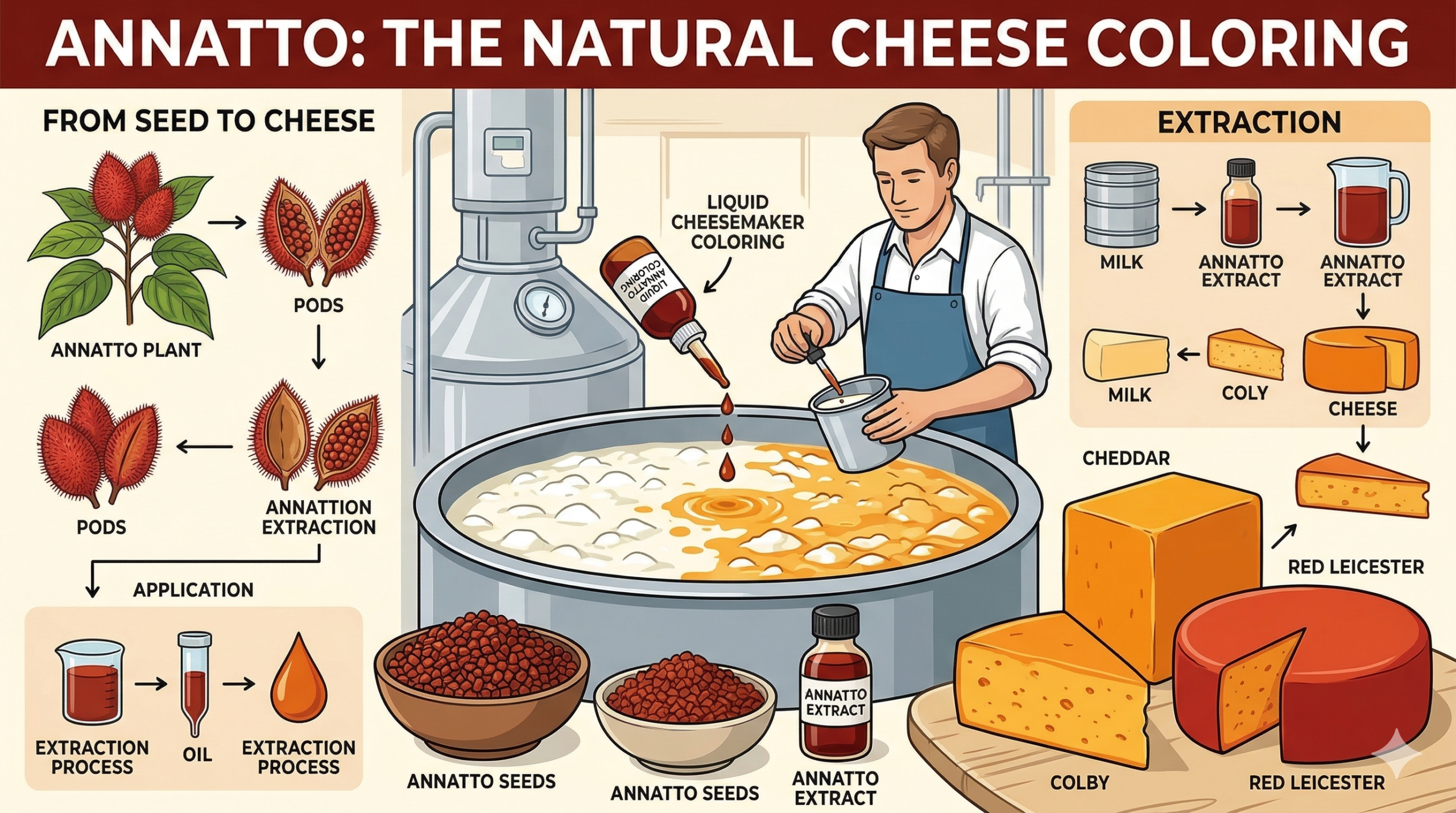
Annatto comes from the seeds of the tropical plant Bixa orellana, native to Central and South America. The seeds contain two primary carotenoid pigments: bixin and norbixin. Bixin is oil-soluble, while norbixin is water-soluble. For cheese production, manufacturers extract norbixin in an alkaline solution to create a water-soluble liquid that disperses evenly throughout milk.
The resulting colorant is classified as a natural food color by the FDA under 21 CFR 73.30. It carries no flavor at the concentrations used in cheese production. Most commercial annatto preparations are standardized to a specific norbixin concentration, typically between 1% and 4%, to ensure batch-to-batch consistency.
How Annatto Works in Cheese Production
When added to milk before coagulation, annatto binds primarily to the casein proteins. This means the color concentrates in the curd rather than the whey. As the curd loses moisture during pressing and aging, the color intensifies further.
Dosing varies by cheese type and desired intensity. As a general guideline, most producers use between 5 mL and 15 mL of standard annatto extract per 100 liters of milk. Deeper orange cheeses like Red Leicester may require higher concentrations, while lighter golden cheeses like Gouda need minimal amounts.
Several factors affect the final color outcome. Milk fat content plays a role, as higher-fat milk produces a richer baseline color. The pH of the milk at the time of addition also matters, since annatto is pH-sensitive and may shift toward red in more acidic conditions. Additionally, aging time and conditions influence the final shade, as moisture loss concentrates the pigment.
Alternative Natural Cheese Colorants
While annatto dominates the cheese coloring market, several other natural options exist for producers seeking different hues or addressing consumer preferences.
Beta-Carotene
Beta-carotene provides a yellow-to-orange color similar to annatto. It is the same pigment found naturally in cow’s milk from pasture-fed animals. Synthetic and plant-derived beta-carotene are both available for dairy use. It is oil-soluble, so it integrates differently into the milk matrix than annatto. Beta-carotene is regulated under FDA 21 CFR 73.95.
Turmeric (Curcumin)
Turmeric extract produces a bright yellow color. Some producers use it for cheeses where a golden rather than orange appearance is desired. However, curcumin can impart a slight flavor at higher concentrations. It is also light-sensitive, meaning color may fade in transparent packaging. Turmeric is approved under 21 CFR 73.615.
Paprika Oleoresin
Paprika oleoresin adds a red-orange hue. It is less commonly used in cheese than annatto but finds application in some specialty and regional cheese varieties. Paprika extracts can carry a mild peppery flavor, so careful dosing is essential. It is regulated under 21 CFR 73.345.
Saffron
Saffron provides a distinctive golden-yellow color and is used in some traditional European cheeses. Its high cost limits commercial application, but it remains relevant for specialty and artisan producers. Saffron also contributes a subtle floral flavor that some cheesemakers consider a feature rather than a drawback.
Practical Dosing and Application for Dairy Producers
Consistent cheese coloring requires a systematic approach. Here are the key steps for incorporating annatto or other natural colorants into your production process.
First, always add the colorant to the milk before adding rennet or cultures. This allows the pigment to distribute evenly throughout the milk before coagulation begins. Stir the milk thoroughly for at least two minutes after adding the colorant to prevent streaking or uneven color patches.
Second, measure precisely. Even small variations in annatto concentration produce visible color differences between batches. Use calibrated syringes or pipettes rather than estimating volumes. Record the exact amount used per batch for traceability and consistency.
Third, account for seasonal milk variation. Milk from pasture-fed cows in summer already contains more natural carotenoids than winter milk. Many producers reduce their annatto dosage by 10–20% during peak grazing months to maintain a consistent final color.
Fourth, test your results. Cut a small piece of curd after pressing and compare it against a reference sample from a previous batch. Color will deepen during aging, so your freshly pressed curd should appear lighter than your target final shade.
Tracking colorant dosing alongside other production parameters helps identify patterns and maintain consistency across seasons and milk sources. Production management software like DairyCraftPro allows producers to log batch-specific additive quantities, making it straightforward to replicate successful color results and troubleshoot any deviations.
Regulatory Considerations for Cheese Coloring
In the United States, the FDA regulates all color additives in food, including those used in cheese. Annatto, beta-carotene, turmeric, and paprika oleoresin are all classified as exempt from certification, meaning they do not require batch-by-batch FDA certification before use. However, they must still be declared on the ingredient label.
The labeling requirement is straightforward. You must list the colorant by its common name (for example, “annatto color” or “annatto extract”) in the ingredient statement. Simply listing “natural color” without specifying the source is not sufficient under current FDA regulations.
For producers exporting cheese, be aware that regulations differ by country. The European Union permits annatto in cheese under Regulation (EC) No 1333/2008 with maximum use levels that vary by cheese type. Canada, Australia, and other markets have their own standards. Always verify the specific requirements for your target export markets.
Consumer Perception and Market Strategy
Color significantly influences consumer purchasing decisions in the cheese aisle. Research consistently shows that consumers associate deeper orange colors with stronger, sharper flavors — even when blind taste tests reveal no difference. This presents both an opportunity and a responsibility for cheese producers.
Understanding your target market is essential. In the Midwest and South of the United States, orange cheddar outsells white cheddar by a wide margin. In the Northeast and in export markets like Canada, white cheddar often commands a premium. Artisan producers can leverage either strategy, positioning their cheese as “traditionally colored” or “all-natural, no added color” depending on their customer base.
Increasingly, consumers are also asking about the source and safety of food colorants. Annatto’s status as a plant-derived, natural colorant is a strong selling point. Clear labeling and transparency about your coloring practices build trust with health-conscious buyers.
Conclusion
Annatto cheese coloring is far more than cosmetic. It connects modern cheese production to centuries of tradition while meeting real consumer expectations about appearance and quality. For dairy producers, mastering natural cheese colorants means achieving consistent, appealing products that stand out in the market.
Whether you use annatto for a classic orange cheddar or skip coloring entirely for a white artisan cheese, the key is consistency and traceability. Logging your colorant type, dosage, and batch results ensures that every wheel or block matches your quality standard. Tools like DairyCraftPro make this process seamless by integrating additive tracking directly into your production workflow.