
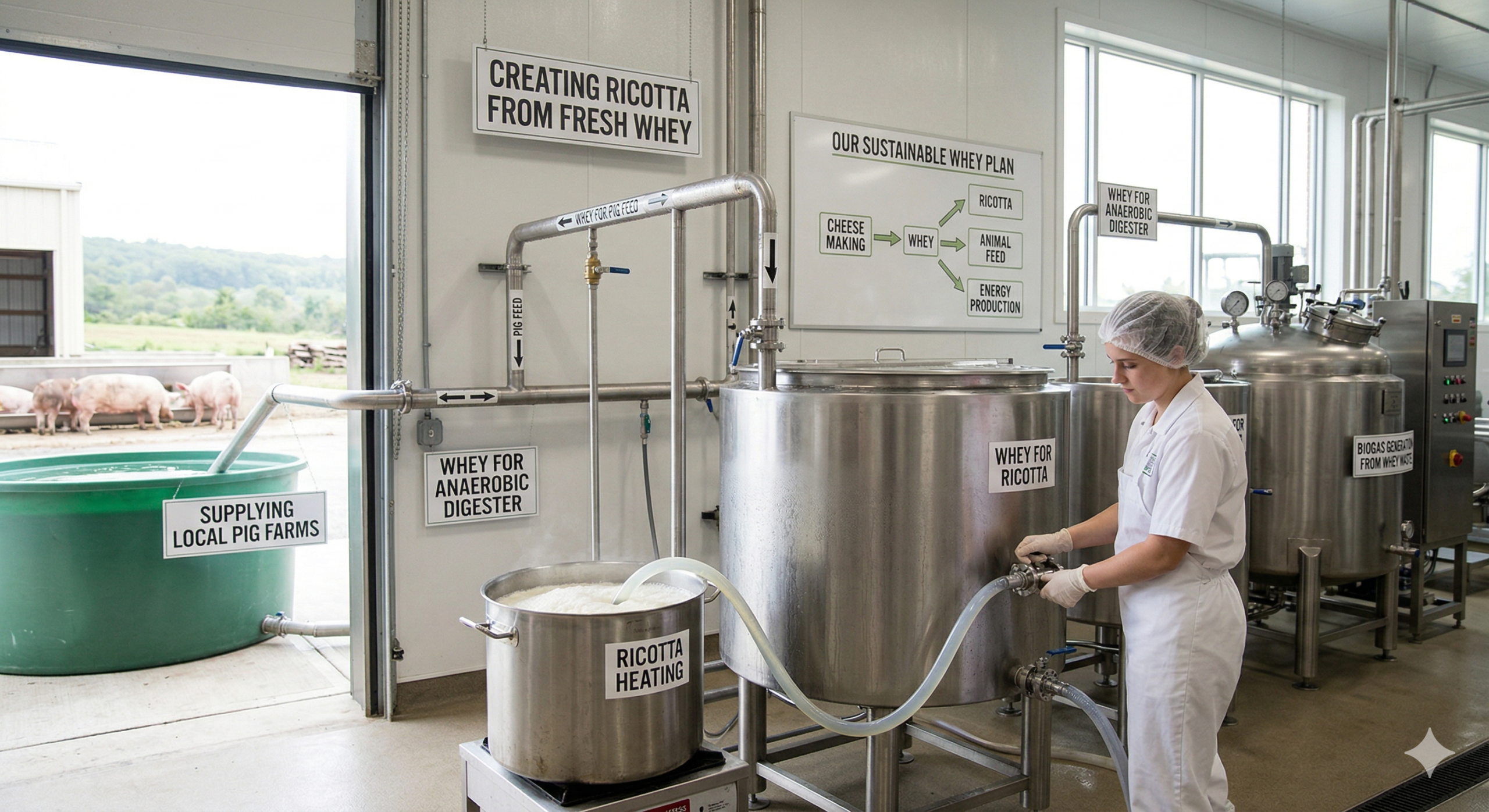
For every kilogram of cheese you produce, approximately nine kilograms of whey remain. This makes whey utilization in cheese production one of the most significant operational and economic considerations for dairy producers. Rather than treating whey as waste, forward-thinking producers are transforming it into valuable products, additional revenue streams, and sustainable practices.
This guide covers the practical methods for utilizing whey from both cheese and yogurt production. From making ricotta to recovering whey protein, you will learn how to maximize the value of every liter of milk that enters your facility.
Understanding Whey: Composition and Types
Whey is the liquid that separates from the curd during cheese production. It retains approximately 50% of the nutrients originally present in milk, making it far too valuable to discard. A typical whey composition includes 93–94% water, 4.5–5% lactose, 0.6–0.8% protein, 0.3–0.5% fat, and 0.5–0.7% minerals.
There are two distinct types of whey, and the distinction matters for utilization.
Sweet Whey
Sweet whey results from rennet-coagulated cheese production. It has a pH between 5.8 and 6.6. This is the whey generated from making hard and semi-hard cheeses such as cheddar, Gouda, Swiss, and mozzarella. Sweet whey contains more lactose and less lactic acid than acid whey, making it easier to process and more versatile in downstream applications.
Acid Whey
Acid whey comes from acid-coagulated dairy products, including Greek yogurt, cream cheese, cottage cheese, and fresh cheeses like queso fresco. It has a pH below 5.1. Acid whey contains higher levels of lactic acid and calcium, which create processing challenges. The high mineral content makes it difficult to dry, and its acidity limits direct food applications.
The growing demand for Greek yogurt has created a significant acid whey disposal challenge in the dairy industry. For every cup of Greek yogurt, roughly two to three cups of acid whey are generated. This makes acid whey management a critical concern for yogurt producers.
Making Ricotta From Whey
The most accessible whey utilization method for small and medium producers is making ricotta cheese. The word “ricotta” literally means “recooked” in Italian, referring to the second heating of whey after primary cheesemaking.
The Process
Ricotta production is straightforward. Heat sweet whey to 85–90°C (185–194°F) without stirring. As the temperature rises, albumin and globulin proteins — which survive the first cheesemaking step — denature and coagulate. They float to the surface as small, fluffy white curds.
Adding a small amount of whole milk (approximately 5–10% by volume) to the whey before heating significantly increases the yield. Some producers also add a small quantity of acid, such as citric acid or white vinegar, to improve protein recovery. However, if your whey is already acidic from a long fermentation, additional acid may not be necessary.
Once the curds form, gently scoop them into cheesecloth-lined molds and allow them to drain for 4–6 hours. The result is a soft, mildly sweet cheese ready for immediate consumption or sale.
Important Limitations
Ricotta can only be made from sweet whey produced by rennet coagulation. Acid whey from yogurt straining or vinegar-based cheeses has already had its secondary proteins precipitated. Attempting to make ricotta from acid whey will yield little to no curd.
Ricotta yield from pure whey is modest — typically 4–6% of the original whey volume. Adding whole milk increases this substantially, but it also changes the product economics. Track your input volumes and output weights to determine whether ricotta production makes financial sense for your operation.
Whey Protein Recovery and Concentration
For producers with higher whey volumes, protein recovery offers significant value. Whey proteins — primarily beta-lactoglobulin and alpha-lactalbumin — are highly nutritious and command premium prices in food, sports nutrition, and pharmaceutical markets.
Ultrafiltration
Ultrafiltration (UF) uses semi-permeable membranes to separate whey proteins from water, lactose, and minerals. The result is whey protein concentrate (WPC), typically containing 35–80% protein depending on the membrane configuration and number of filtration stages. UF is the most common method for small to mid-scale operations looking to add value to their whey stream.
Nanofiltration and Reverse Osmosis
Further concentration can be achieved through nanofiltration or reverse osmosis. These processes remove additional water and partially demineralize the whey, producing a more concentrated product suitable for drying. Spray drying the concentrate produces whey protein powder, which has a shelf life of 12–24 months and is easy to transport and sell.
Practical Considerations
Membrane filtration equipment represents a significant capital investment. For smaller producers, cooperative arrangements — where multiple facilities send their whey to a shared processing center — can make protein recovery economically viable. Evaluate your daily whey volume, local market demand for whey protein products, and the distance to potential buyers before investing.
Acid Whey Solutions for Yogurt Producers
Acid whey disposal is one of the most pressing challenges facing yogurt producers today. Its high biological oxygen demand (BOD) means it cannot simply be discharged into municipal wastewater systems without treatment. Several solutions exist, each with different cost and complexity profiles.
Animal Feed
Acid whey can be fed directly to livestock, particularly pigs, which readily consume it. This is the simplest disposal method and provides nutritional value to the animals. However, transportation costs and limited farm proximity may make this impractical for urban or suburban facilities.
Anaerobic Digestion
Feeding acid whey into an anaerobic digester converts the lactose and organic matter into biogas (methane). This biogas can be used to offset facility energy costs. Some larger operations generate enough biogas from whey to power a significant portion of their heating needs.
Lactose Recovery
The high lactose content of acid whey makes lactose recovery an option. Crystallized lactose has applications in pharmaceutical manufacturing, infant formula, and confectionery. However, the high mineral content of acid whey complicates the crystallization process and may require additional demineralization steps.
Fermentation to Ethanol
Research has demonstrated the feasibility of fermenting whey lactose into bioethanol. While not yet widely commercialized at small scale, this represents a growing opportunity as sustainability demands increase.
Tracking Whey Output for Better Production Economics
Understanding your whey output per batch is fundamental to evaluating utilization options. Key metrics to track include whey volume per batch, whey pH immediately after draining, fat content of the whey (which indicates curd handling efficiency), and protein content.
Consistent tracking reveals patterns. If your whey fat content is creeping upward, it may indicate that your cutting or stirring technique is losing fat to the whey rather than retaining it in the curd. If whey pH varies significantly between batches, your culture activity may be inconsistent.
DairyCraftPro allows producers to log whey metrics alongside their standard batch production data. By monitoring whey characteristics over time, you can optimize both your primary cheese or yogurt production and your whey utilization strategy simultaneously.
Environmental and Regulatory Context
Whey disposal is regulated in most jurisdictions. In the United States, the EPA classifies whey as a high-strength organic waste. Discharging untreated whey into waterways is prohibited due to its high BOD, which depletes dissolved oxygen and harms aquatic ecosystems. Even discharging to municipal wastewater systems typically requires pretreatment and incurs surcharges based on BOD levels.
These regulations make whey utilization not just economically attractive but operationally necessary. Producers who convert whey into salable products or useful byproducts avoid disposal costs while generating additional revenue. It transforms an environmental liability into a business asset.
Conclusion
Whey utilization in cheese and yogurt production is no longer optional — it is an economic and environmental imperative. From simple ricotta production to advanced protein recovery, the options available to dairy producers are broader than ever.
Start by tracking your whey volumes and characteristics with each production batch. This data forms the foundation for evaluating which utilization methods make the most sense for your facility, scale, and market. With the right approach, the nine kilograms of whey produced alongside every kilogram of cheese become not waste, but opportunity.
Explore how DairyCraftPro can help you track batch yields, whey output, and production economics to make informed decisions about your whey management strategy.